






LIBRARY
Dayal Patterson
"Black Metal: Evolution of the Cult" 2013
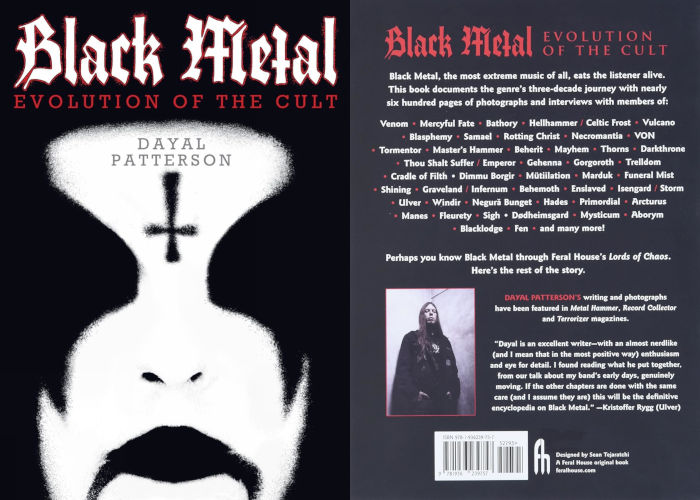
Paperback: 600 pages
Publisher: Feral House (November 12, 2013)
Language: English
ISBN-10: 1936239752
ISBN-13: 978-1936239757
Item Weight: 2.48 pounds
Dimensions: 7 x 1.5 x 10 inches
"Black Metal: Evolution of the Cult" features over one hundred exclusive new and archival interviews with the genre's most central figures. It is the most comprehensive guide yet to this fascinating and controversial form of extreme metal. It is encyclopaedic in length and breadth.
From the early 1980s pioneers to its fiery rebirth in Scandinavia through to today's increasingly diverse groups, this epic tome captures the movement's development in unparalleled detail and images through such bands and personalities as Dimmu Borgir, Mayhem, Behemoth, Tormentor, Emperor, Darkthrone, Samael, Gorgoroth, and many dozens of others.
Increasingly influential, Black Metal continues to grow and expand as a musical form as well as the subject of serious and satirical, animated, documentary, and narrative feature films.
Publisher Feral House has already published the most famous and award-winning book about this subculture, "Lords of Chaos", soon to become a narrative feature film directed by Jonas Åkerlund, an ex-Black Metal musician who has directed feature films and award-wining videos for the likes of Madonna and Lady Gaga.
From the early 1980s pioneers to its fiery rebirth in Scandinavia through to today's increasingly diverse groups, this epic tome captures the movement's development in unparalleled detail and images through such bands and personalities as Dimmu Borgir, Mayhem, Behemoth, Tormentor, Emperor, Darkthrone, Samael, Gorgoroth, and many dozens of others.
Increasingly influential, Black Metal continues to grow and expand as a musical form as well as the subject of serious and satirical, animated, documentary, and narrative feature films.
Publisher Feral House has already published the most famous and award-winning book about this subculture, "Lords of Chaos", soon to become a narrative feature film directed by Jonas Åkerlund, an ex-Black Metal musician who has directed feature films and award-wining videos for the likes of Madonna and Lady Gaga.
© 2013 Feral House (USA)
Chapter 22: Burzum
"Filosofem" is a perfect album, it doesn't even need any words as it's so perfect it's beyond belief. You can't believe that a human being has been capable of carving that out of nothing, it's amazing.
Niklas Kvarforth (Shining)
AS A ONE-MAN PROJECT - perhaps the most famous within the metal world - the story of Burzum is intrinsically linked to that of its creator, Varg Vikernes. Since we have already examined the impact his presence and actions had upon the Norwegian Black Metal scene, there is probably no need to delve further into the events that led to his lengthy imprisonment. In fact, the point that needs to be highlighted is that while his crimes and controversial opinions are certainly responsible for a large part of his fame, on artistic merit alone he would be considered one of the genre's most significant and influential artists.
Born in Bergen under the name Kristian, Varg's early teens were characterized by a fascination with roleplaying games, warfare, and metal music. Along with this came a focus on race and nationality, which began during his childhood in Iraq, where his father was working for Saddam Hussein - a figure he actually hails in early Burzum interviews (Hussein, that is; Varg's father seems to have become a somewhat distant figure after his parents divorced when he was twelve). According to Varg's homepage, he first began making music in a metal trio named Kalashnikov (after the Russian assault rifle) and later renamed Uruk-Hai, after the toughest orcs in J.R.R. Tolkein's "Lord of the Rings".
No recordings appear to have been made by this outfit, and soon Varg became a part of Old Funeral (joining just before Olve "Abbath" Eikemo and Harald "Demonaz" Nævdal departed to form Immortal), playing guitar on the 1991 EP "Devoured Carcass". As the Black Metal revolution overtook Norway, Old Funeral would gradually splinter into new groups, and in Varg's case this led to him working on his solo project Burzum, the name once again from "Lord of the Rings" (it means "darkness" in the Black Speech of Mordor).
Vikernes then underwent an almost unbelievably productive period of writing, crafting a huge library of songs that would furnish a spree of future releases. Writing alone, Varg's compositions were defined by his use of hypnotic repetition, catchy yet melancholic riffs, simple yet perfectly suited drum and guitar work, and his uniquely tortured screams. With no input from other musicians, it was presumably his own listening tastes that dictated the Burzum sound: certainly Varg was always open in his passion for Bathory and VON, with early fanzine interviews also namechecking Mayhem and Thorns. Later autobiographical writings also cite the first Paradise Lost demo, Destruction and Celtic Frost, Dutch death metallers Pestilence, and some "underground house/techno" recordings. In an interview in 2010 for "Metal Hammer", he also told me that he now believed Iron Maiden and the first two Kreator albums had the most impact on him, with Destruction's solos on "Infernal Overkill" specifically inspiring him to make his riffs "solo-like", and Bathory inspiring his drumming to be simple and "drum machine-like".
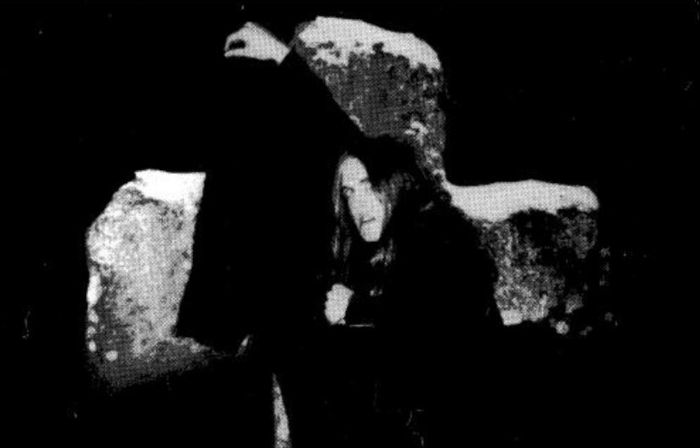
An early Burzum promo photo of Varg Vikernes, captured in his Count Grishnackh persona.
His entrance into the Oslo scene led to Euronymous signing Burzum after two 1991 demo tapes, releasing the self-titled debut album on Deathlike Silence in 1992, the first Black Metal release on the label. As with Old Funeral, Varg recorded in Bergen at Grieghallen with producer Eirik "Pytten" Hundvin (a relationship that would prove enduring), with his friends Demonaz and Euronymous present, the latter providing a guitar solo on the short and Bathory-esque "War." The album would prove as essential in cementing the second wave template as "Diabolical Fullmoon Mysticism" by Varg's friends and ex-bandmates Immortal, and Darkthrone's similarly monochromatic "A Blaze in the Northern Sky". The epic yet bleak atmosphere was all-encompassing, the songs embodying a duality: a sense of calming catharsis alongside an oppressive, claustrophobic overtone.
For a time, Varg - now better known as Count Grishnackh (Grishnákh being a particularly malevolent orc from "Lord of the Rings") - sought to turn Burzum into a full band, and invited in drummer Erik Lancelot (later of Ulver) and Emperor's Tomas "Samoth" Haugen on bass. The latter would appear on the iconic "Aske" EP (notoriously featuring the burnt remains of Fantoft Church and packaged with a lighter featuring the same image), but Varg would quickly return the band to a solo effort, having lost interest in the prospect of playing live.
For a time, Varg - now better known as Count Grishnackh (Grishnákh being a particularly malevolent orc from "Lord of the Rings") - sought to turn Burzum into a full band, and invited in drummer Erik Lancelot (later of Ulver) and Emperor's Tomas "Samoth" Haugen on bass. The latter would appear on the iconic "Aske" EP (notoriously featuring the burnt remains of Fantoft Church and packaged with a lighter featuring the same image), but Varg would quickly return the band to a solo effort, having lost interest in the prospect of playing live.
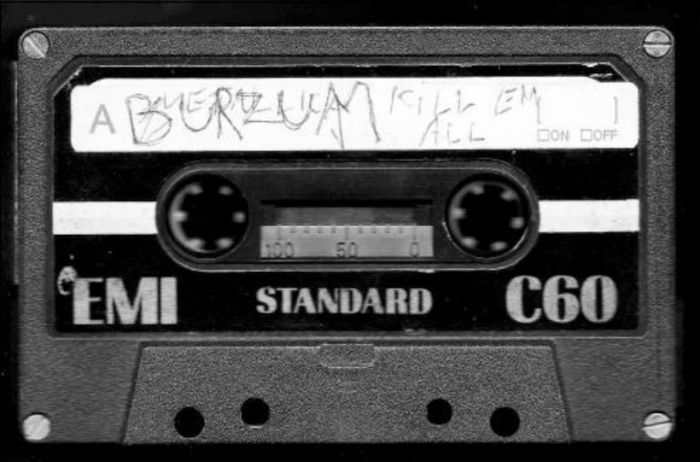
A cassette featuring early mixes of Burzum's debut album (minus the ambient tracks) sent to Euronymous, who was releasing the record. Recorded over Metallica's "Kill 'Em All", it features Varg's handwriting and was rescued from Euronymous' apartment following his death.
"Aske" would be released in 1993 on Varg's own Cymophane label, due to the collapse of his friendship with Euronymous, as would the second full-length "Det Som Engang Var" ("What Once Was"), though both were actually recorded in 1992. Since this material was written around the same time as the debut, it's unsurprising that it bears many similarities, though the experience in the studio seems to have given the songs greater depth and more intricate textures. The basic approach remained largely unchanged, however, and as before Varg sought to distance himself from the precision playing and equipment he associated with Death Metal, instead using whatever tools he happened to have access to. Tone and feel were prioritized above technical details, an approach that served as a defining quality of Black Metal in general.
"We were searching around trying to find different sounds on different amps and speakers to get this cold and narrow sound, which we have on at least the first three Burzum albums", recalls Pytten. "We used very traditional drum recording techniques but if you want to produce a good, traditional rock'n'roll drum sound you would need a good rock'n'roll drum kit - and these guys never had a good drum kit. But if you take an unskilled musician and put them on an instrument or amp that they don't know, you won't get a better result... because if you don't know [an instrument] you can't express yourself on it... You also don't produce an [intentionally] ugly sound with really high-class equipment, you use a speaker which is not completely as it should be".
Initially distributed by Voices of Wonder, Varg was soon handed back their stock of records when the label decided they wished to cut ties with this increasingly contentious character as quickly as possible. Left without distribution and now in jail for a lengthy murder sentence, Varg initially sought help from Metalion, who sold some records as a favor but felt that Head Not Found was not properly equipped to handle Burzum. Earache Records had at one point courted Varg, but were put off by comments they felt were explicitly racist. For the same reason, Candlelight decided not to sign him, since they feared a boycott might lead to them losing distribution for all their artists.
The solution came from England and Tiziana Stupia, a Burzum fan who set up the Misanthropy Records label in order to give Varg the distribution he was unable to find elsewhere. Despite this, the label later voiced complaints (in particular via a compilation aptly titled "Presumed Guilty") about artists on their label losing distribution from Rough Trade for this very reason - though there's little doubt that the notoriety and huge success of Burzum also helped the label expand their roster considerably.
1994's "Hvis Lyset Tar Oss" ("If the Light Takes Us") became the first album to be released through Cymophone and Misanthropy. Remarkably, this album had also been recorded in 1992, just a few short months after "Det Som Engang Var" and a mere month after "Aske". Despite this, a notable stylistic leap had taken place, the record boasting four lengthy numbers that resonate with a greater emotional scope than its predecessors, bearing a distinctly yearning atmosphere and an expansive, heavily synth-laden sound. Epic, bleak, and built around the huge trademark riffs, the album is again peaceful at times, while also presenting Burzum at its most discordant and abrasive; it is rightly considered a milestone in Black Metal.
The next release would be the final one in the first chapter of the project's history and arguably its finest effort, taking the genre to even more transcendental levels. Recorded back in 1993 but not released until three years later, "Filosofem" opens with the unbelievably atmospheric and immersive "Dunkelheit". With a title that translates as "darkness" (the song's "real name", Varg has explained, is "Burzum", but all titles were in German for the initial release), it was reportedly written back in 1991, and was apparently the first real song Varg wrote for Burzum. With a hypnotic riff, a ridiculously simple yet perfect synth accompaniment and mantra-like lyrics, the track is the closest Burzum have yet come to a single, and was even given its own promo video. The more ferocious and relentless "Jesu Død" is another highlight, as is a dark yet strangely soothing twenty-five-minute ambient number whose title translates as "Circumambulation of the Transcendental Pillar of Singularity".
Once imprisoned, Varg lost access to all instruments but a keyboard and so it was that his next release was an ambient album entitled "Dauði Baldrs". Unveiled in 1997, it failed to impress, and while the follow-up, 1999's "Hliðskjálf", was a marked improvement, it's interesting that these albums never reached the heights of the earlier ambient tracks that helped define the first four albums. Sadly "Dauði Baldrs" was the last release for over a decade, and during the rest of his incarceration Varg seemed keen to distance himself from Burzum, the Black Metal scene, and any Satanic associations that went with it.
"We were searching around trying to find different sounds on different amps and speakers to get this cold and narrow sound, which we have on at least the first three Burzum albums", recalls Pytten. "We used very traditional drum recording techniques but if you want to produce a good, traditional rock'n'roll drum sound you would need a good rock'n'roll drum kit - and these guys never had a good drum kit. But if you take an unskilled musician and put them on an instrument or amp that they don't know, you won't get a better result... because if you don't know [an instrument] you can't express yourself on it... You also don't produce an [intentionally] ugly sound with really high-class equipment, you use a speaker which is not completely as it should be".
Initially distributed by Voices of Wonder, Varg was soon handed back their stock of records when the label decided they wished to cut ties with this increasingly contentious character as quickly as possible. Left without distribution and now in jail for a lengthy murder sentence, Varg initially sought help from Metalion, who sold some records as a favor but felt that Head Not Found was not properly equipped to handle Burzum. Earache Records had at one point courted Varg, but were put off by comments they felt were explicitly racist. For the same reason, Candlelight decided not to sign him, since they feared a boycott might lead to them losing distribution for all their artists.
The solution came from England and Tiziana Stupia, a Burzum fan who set up the Misanthropy Records label in order to give Varg the distribution he was unable to find elsewhere. Despite this, the label later voiced complaints (in particular via a compilation aptly titled "Presumed Guilty") about artists on their label losing distribution from Rough Trade for this very reason - though there's little doubt that the notoriety and huge success of Burzum also helped the label expand their roster considerably.
1994's "Hvis Lyset Tar Oss" ("If the Light Takes Us") became the first album to be released through Cymophone and Misanthropy. Remarkably, this album had also been recorded in 1992, just a few short months after "Det Som Engang Var" and a mere month after "Aske". Despite this, a notable stylistic leap had taken place, the record boasting four lengthy numbers that resonate with a greater emotional scope than its predecessors, bearing a distinctly yearning atmosphere and an expansive, heavily synth-laden sound. Epic, bleak, and built around the huge trademark riffs, the album is again peaceful at times, while also presenting Burzum at its most discordant and abrasive; it is rightly considered a milestone in Black Metal.
The next release would be the final one in the first chapter of the project's history and arguably its finest effort, taking the genre to even more transcendental levels. Recorded back in 1993 but not released until three years later, "Filosofem" opens with the unbelievably atmospheric and immersive "Dunkelheit". With a title that translates as "darkness" (the song's "real name", Varg has explained, is "Burzum", but all titles were in German for the initial release), it was reportedly written back in 1991, and was apparently the first real song Varg wrote for Burzum. With a hypnotic riff, a ridiculously simple yet perfect synth accompaniment and mantra-like lyrics, the track is the closest Burzum have yet come to a single, and was even given its own promo video. The more ferocious and relentless "Jesu Død" is another highlight, as is a dark yet strangely soothing twenty-five-minute ambient number whose title translates as "Circumambulation of the Transcendental Pillar of Singularity".
Once imprisoned, Varg lost access to all instruments but a keyboard and so it was that his next release was an ambient album entitled "Dauði Baldrs". Unveiled in 1997, it failed to impress, and while the follow-up, 1999's "Hliðskjálf", was a marked improvement, it's interesting that these albums never reached the heights of the earlier ambient tracks that helped define the first four albums. Sadly "Dauði Baldrs" was the last release for over a decade, and during the rest of his incarceration Varg seemed keen to distance himself from Burzum, the Black Metal scene, and any Satanic associations that went with it.
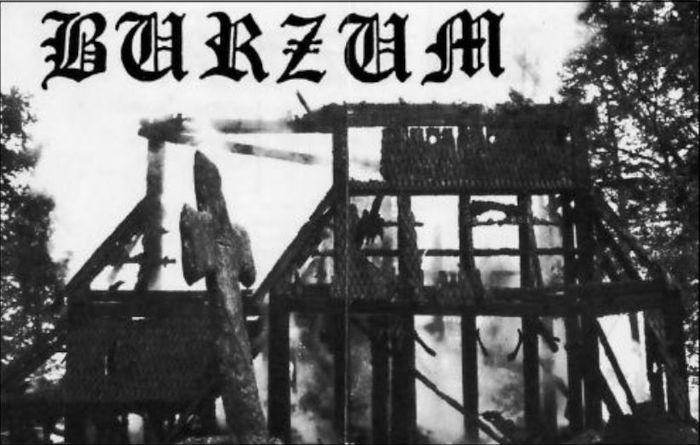
A flyer for 1993's "Aske" EP, featuring the burnt remains of Fantoft Stave Church, one of the few church arsons for which Varg was not found guilty.
Often using the Germanic pen name Hofding Warge, he instead concentrated on his ideological writings. The "Filosofem" CD had already included the postal address for the National Heathen Front, a group primarily concerned with race and ecology, and Varg was now increasingly outspoken about his Odinism and extreme right-wing/race-related views, which he not only espoused in his book "Vargsmål", but in the journal "Filosofem". Swastikas now appeared in the borders of his written correspondence, and he was famously quoted claiming that looking into brown eyes was like "looking up an arsehole". Misanthropy meanwhile released a Burzum shirt with a totenkopf (the SS skull and crossbones) urging the reader to support their local Einsatzkommando (a term used to describe the killing squads in occupied territories of Nazi Germany whose targets were Jews, communists, and other ideological enemies). Varg became something of a figurehead for the right-wing music scene, with leading far-right label Resistance Records even buying Cymophane. While some didn't care for the man's politics, many were disappointed by statements that suggested that any future recordings would remain clear of Black Metal due to Varg's disdain for the genre and "negro" instruments.
But when released from prison in 2009 - after a highly publicized escape attempt in 2003 in which he was reportedly captured in a stolen car full of weapons and equipment from a military barracks (though he denies possession of any weapons) - Varg in fact quickly returned to making metal with Burzum, beginning with the 2010 "Belus" album. Originally given the delicate title "The White God", the statement that accompanied its release proved Varg was in no mood for diplomacy.
"I am no friend of the modern so-called Black Metal culture. It is a tasteless, lowbrow parody of Norwegian so-called Black Metal anno 1991-1992, and if it was up to me it would meet its dishonorable end as soon as possible. However, rather than abandon my own music, only because others have soiled its name by claiming to have something in common with it, I will stick to it. The "Black Metallers" will probably continue to "get loaded", "get high", and in all other manners to behave like the stereotypical Negro; they will probably continue to get foreign tribal tattoos, dress, walk, talk, look, and act like homosexuals, and so forth. Some of the "Black Metallers", their fans and accomplices will probably even continue to pretend - and actually believe - they have something in common with Burzum, but let me assure you; they don't".
There's no doubt that Varg's statements in magazines (and on his website, which even relatively recently mentions "negroes and other inferior races") have long been politically charged, yet unlike most similarly minded artists his views have never found their way into his music. In fact, perhaps paradoxically, Burzum's huge popularity suggests that Varg has managed to tap into something truly universal. Though the post-prison albums (which include 2011's "Fallen" and 2012's "Umskiptar") have not proven quite as significant as those recorded prior to his incarceration, Burzum remains hugely popular with a wide array of listeners, including those who completely disregard Varg's politics and worldview, which now seems to eschew the Odinist faith of his early prison years for what he calls a non-religious paganism.
"My guess would be a common feeling of despair", Varg explained in my 2010 "Metal Hammer" interview, when asked why he thought his music resonates with so many people. "And perhaps we also share the feeling of being alienated and even ostracized in a world that used to be ours, but isn't any more. Or perhaps it's simply because I am untrained and from a different musical background (classical), and because of that make music that is slightly different from the music made by those who are trained and hail from a traditional metal background. It might also be because I do everything myself, and therefore [the music] is less compromising. I really don't know. I am happy if others like my music, but I don't spend much time figuring out exactly why they do".
Whatever the reason, countless new Black Metal bands continue to appear with a clearly audible Burzum influence. In fact, along with Darkthrone, Burzum has proved arguably the most directly influential outfit in the genre and it's no exaggeration to say that a vast proportion of groups in today's scene simply would not sound the way they do if it were not for this eternally contentious outfit.
But when released from prison in 2009 - after a highly publicized escape attempt in 2003 in which he was reportedly captured in a stolen car full of weapons and equipment from a military barracks (though he denies possession of any weapons) - Varg in fact quickly returned to making metal with Burzum, beginning with the 2010 "Belus" album. Originally given the delicate title "The White God", the statement that accompanied its release proved Varg was in no mood for diplomacy.
"I am no friend of the modern so-called Black Metal culture. It is a tasteless, lowbrow parody of Norwegian so-called Black Metal anno 1991-1992, and if it was up to me it would meet its dishonorable end as soon as possible. However, rather than abandon my own music, only because others have soiled its name by claiming to have something in common with it, I will stick to it. The "Black Metallers" will probably continue to "get loaded", "get high", and in all other manners to behave like the stereotypical Negro; they will probably continue to get foreign tribal tattoos, dress, walk, talk, look, and act like homosexuals, and so forth. Some of the "Black Metallers", their fans and accomplices will probably even continue to pretend - and actually believe - they have something in common with Burzum, but let me assure you; they don't".
There's no doubt that Varg's statements in magazines (and on his website, which even relatively recently mentions "negroes and other inferior races") have long been politically charged, yet unlike most similarly minded artists his views have never found their way into his music. In fact, perhaps paradoxically, Burzum's huge popularity suggests that Varg has managed to tap into something truly universal. Though the post-prison albums (which include 2011's "Fallen" and 2012's "Umskiptar") have not proven quite as significant as those recorded prior to his incarceration, Burzum remains hugely popular with a wide array of listeners, including those who completely disregard Varg's politics and worldview, which now seems to eschew the Odinist faith of his early prison years for what he calls a non-religious paganism.
"My guess would be a common feeling of despair", Varg explained in my 2010 "Metal Hammer" interview, when asked why he thought his music resonates with so many people. "And perhaps we also share the feeling of being alienated and even ostracized in a world that used to be ours, but isn't any more. Or perhaps it's simply because I am untrained and from a different musical background (classical), and because of that make music that is slightly different from the music made by those who are trained and hail from a traditional metal background. It might also be because I do everything myself, and therefore [the music] is less compromising. I really don't know. I am happy if others like my music, but I don't spend much time figuring out exactly why they do".
Whatever the reason, countless new Black Metal bands continue to appear with a clearly audible Burzum influence. In fact, along with Darkthrone, Burzum has proved arguably the most directly influential outfit in the genre and it's no exaggeration to say that a vast proportion of groups in today's scene simply would not sound the way they do if it were not for this eternally contentious outfit.