






LIBRARY
Varg Vikernes: God or Satan?
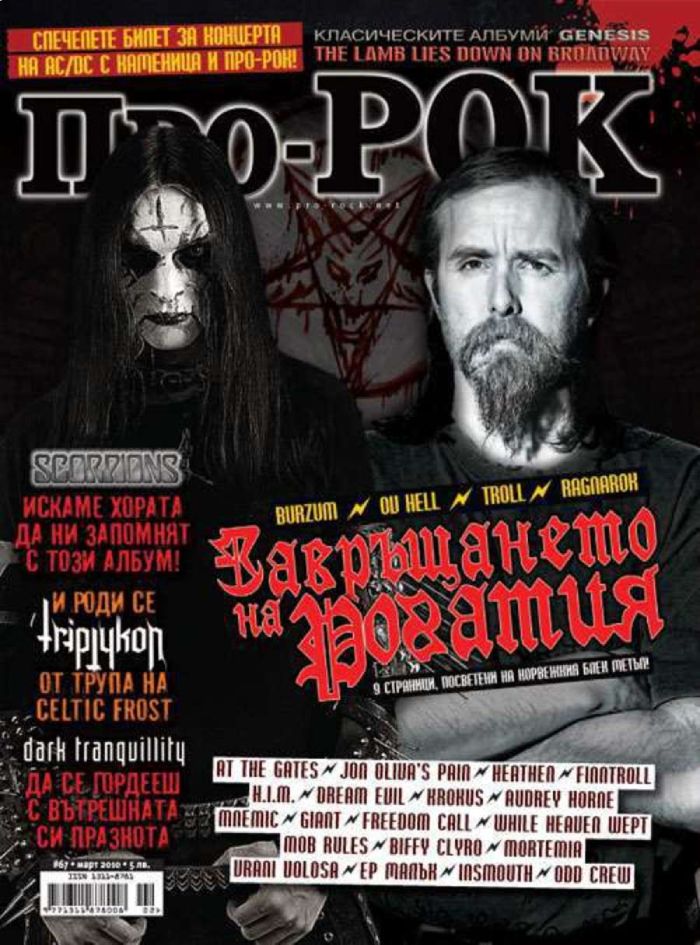
"Pro-Rock" Magazine (#67, 2010)
Viktor Kolev
N
o one could have predicted the worldwide impact the evocative murder of Euronymous (Mayhem) would have. No one can say what the modern Black Metal scene would have been without Varg Vikernes. We can say, however, that with "Belus" a long and painful wait is ended.
***
The White God
""Belus" album has been made according to my heart and spirit, and not to fit into any particular genre or category, or to live up to anyone's obvious expectations". These are the opening words of Varg Vikernes when he presents "Belus" on his official website. And for his old work is too laconic. "The début album was intentionally anti-commercial and anti-Death Metal, the "Det Som Engang Var" album was experimental, the "Hvis Lyset Tar Oss" album was intentionally monotonous and ritual, the "Filosofem" album was intentionally different from the others, "Dauði Baldrs" was what I could do from a prison cell, and "Hliðskjálf" too".
The original title of the record is "Den Hvite Guden" (The White God), the story revolves around the myths of the White God (Baldur), also known by the names Apollon, Baldr, Belenus, Belus, Bragi, Byelobog, Jarilo and others. Such a direct title, however, evokes associations with the overt racism of Varg, and very soon all the media attention is staring and demanding an explanation of the meaning of such a title. The focus began to shift, and although Varg tried to explain that there was no political message behind the title, he eventually decided to change the name to "Belus" to cut off any speculation and the entire anti-Varg and anti-Burzum campaign. "I am aware of the black metal association with the name Burzum, and I have no real and serious problem with that, but I personally see no reason to place "Belus" in any category. I think "Belus" musically transcends all existing categories, but if I have to choose one - and for the sake of simplicity - I will simply place it in the metal category".
The original title of the record is "Den Hvite Guden" (The White God), the story revolves around the myths of the White God (Baldur), also known by the names Apollon, Baldr, Belenus, Belus, Bragi, Byelobog, Jarilo and others. Such a direct title, however, evokes associations with the overt racism of Varg, and very soon all the media attention is staring and demanding an explanation of the meaning of such a title. The focus began to shift, and although Varg tried to explain that there was no political message behind the title, he eventually decided to change the name to "Belus" to cut off any speculation and the entire anti-Varg and anti-Burzum campaign. "I am aware of the black metal association with the name Burzum, and I have no real and serious problem with that, but I personally see no reason to place "Belus" in any category. I think "Belus" musically transcends all existing categories, but if I have to choose one - and for the sake of simplicity - I will simply place it in the metal category".
Burzum does Burzum
This is probably the best way to characterize "Belus". Even after 16 years in prison, Varg seems to have conserved his creative energy by offering an album that is a logical follow-up to his 1996 release "Filosofem". Vikernes himself described "Belus" as "something similar to "Hvis Lyset Tar Oss" and "Filosofem"".
There is also something symbolic in the choice of the iconic Grieghallen studio (Grieg's concert hall) and producer Pytten, who worked there on albums of the first half of the 90s with Burzum, Mayhem, Immortal, Emperor, Gorgoroth. "If something works, don't change it" is Vikernes' motto, but it is immediately noticeable that the bass guitar is much better produced than in previous Burzum albums. However, the big debate raging among fans is whether the drums are from a drum machine or played by Varg. There are even maniacs who have put the percussion from "Belus" through a computer program and have seen a total perfection in the beats, which is impossible to achieve by a human, even after all the studio adjustments by the producer. The conspiracy theory is that Varg is lying that he played the drums because after a long time in prison he is no longer in the shape... Burzum's albums have also always been characterized by references to the past, in "Belus" these are the tracks "Belus' Død" (Belus' Death), the original version of which appeared as an idea in "Dauði Baldrs", and the song "Sverddans" (Sword Dance), the original idea of which was back in 1988-1989 in the group Uruk-Hai (here he briefly partnered with Fenriz from DarkThrone). Naturally, a dispute immediately arose among fans as to which riff is more majestic: whether "Belus' Død" or from the song "Jesus' Tod" from "Filosofem", and also whether "Sverddans" is now some form of addition from the idea of "War" song of Burzum's début album.
There is also something symbolic in the choice of the iconic Grieghallen studio (Grieg's concert hall) and producer Pytten, who worked there on albums of the first half of the 90s with Burzum, Mayhem, Immortal, Emperor, Gorgoroth. "If something works, don't change it" is Vikernes' motto, but it is immediately noticeable that the bass guitar is much better produced than in previous Burzum albums. However, the big debate raging among fans is whether the drums are from a drum machine or played by Varg. There are even maniacs who have put the percussion from "Belus" through a computer program and have seen a total perfection in the beats, which is impossible to achieve by a human, even after all the studio adjustments by the producer. The conspiracy theory is that Varg is lying that he played the drums because after a long time in prison he is no longer in the shape... Burzum's albums have also always been characterized by references to the past, in "Belus" these are the tracks "Belus' Død" (Belus' Death), the original version of which appeared as an idea in "Dauði Baldrs", and the song "Sverddans" (Sword Dance), the original idea of which was back in 1988-1989 in the group Uruk-Hai (here he briefly partnered with Fenriz from DarkThrone). Naturally, a dispute immediately arose among fans as to which riff is more majestic: whether "Belus' Død" or from the song "Jesus' Tod" from "Filosofem", and also whether "Sverddans" is now some form of addition from the idea of "War" song of Burzum's début album.
Anti-"Belus" campaign
Naturally, when your name is Varg Vikernes and you are marked by the historical events of the Black Metal scene, it is normal to collect a huge negative energy. In the age of information society, everyone can express his or her opinion in some way. There are absurdities that Varg paid other musicians to record his album because he was in complete creative limbo. Some miss the vocals in "Det Som Engang Var", while others openly state that if the cover of "Belus" had not had Burzum logo, this record would have been forgotten in a month. Another one was annoyed by the clean vocals in "Kaimadalthas' Nedstigning" (Kaimadalthas' Descent) because the repetition of the same words sounded like a self-taught Norwegian.
Undoubtedly, the biggest attack, quite unexpectedly, came from Digby Pearson, owner of Earache Records. "Stay away from "Belus"! The album is rubbish. Is that all he can offer as a return after a 16-year hiatus?", accompanied by a link for illegal downloading from the Internet. It's very rare to see a label providing illegal downloadable material, but Digby's hatred of Varg seems to have led him to violate the code of business ethics. It had its own story in 1993. Earache desperately trying to sign with Varg. Digby paid Varg's full expenses to Nottingham for a meeting to clarify the contract parameters. The fun begins at the airport when Varg's metal belts and spikes whiz at every detector, but the proud Norwegian refuses to take them off and is an absolute attraction for ordinary people. A long conversation ensues in a pizzeria, and Digby is almost ready to sign with Varg right away when Varg suddenly starts talking about his racist and right-wing political views, which casts a quiet horror on Digby, who imagines the anti-NS Napalm Death under a label hat with racist attitudes of Varg. Although Varg spent all day playing tracks from his upcoming albums for Digby, the boss of Earache could not afford himself to sign with Burzum, and after Varg returned to Norway, he never contacted him again. At least until "Belus", when the accumulated bitterness is poured out... or is Digby just mad at him for not holding onto the rights to the return of Burzum?
"I have been ready to return to normal society for many years. I learned from my mistakes and gained experience. My mind was never locked behind bars because all these years I've been thinking about the day I'll be with my family". These are some of the words spoken in July 2008. Vikernes is pleading for parole. Sentenced to the maximum sentence in Norway of 21 years (for the murder of Euronymous and the arson of three churches in Norway), he can be released after 12 years by law. During this time, however, there was a change in the law and the minimum sentence for murder was extended from 12 to 14 years.
In 2003, however, Varg made an unsuccessful escape attempt, committed a carjacking, and when he was captured by the police, they found in it a gun, knives, and other gadgets that every statistically average terrorist has. The explanations begin with an attempt to escape to Sweden, the theory that he wanted to join the French Legion (whose ranks don't matter what your background is), and finally come to an intimate conversation with his mother, who convinced him to surrender to the authorities. Police have no evidence, but they are certain that Varg had associates, most likely from far-right groups. The whole story leads to his sentence being increased by an additional two years in prison for the escape attempt.
Therefore, after four applications for early release and 16 years behind bars under an initially strict regime on 22 May 2009 Varg is a free man. Despite the negative comments and controversial statements, Vikernes has always shown himself to be extremely attached to family values. He has a 17-year-old daughter, a 2-year-old son and is expecting a third child. It turns out that even though he was a murderer, due to good behavior during much of his effective sentence, he was entitled to short releases to see his family. In prison, he could not have instruments, but he managed to get a computer with which he recorded the electronically oriented albums "Dauði Baldrs" and "Hliðskjálf", and in recent years he was allowed a acoustic guitar.
Undoubtedly, the biggest attack, quite unexpectedly, came from Digby Pearson, owner of Earache Records. "Stay away from "Belus"! The album is rubbish. Is that all he can offer as a return after a 16-year hiatus?", accompanied by a link for illegal downloading from the Internet. It's very rare to see a label providing illegal downloadable material, but Digby's hatred of Varg seems to have led him to violate the code of business ethics. It had its own story in 1993. Earache desperately trying to sign with Varg. Digby paid Varg's full expenses to Nottingham for a meeting to clarify the contract parameters. The fun begins at the airport when Varg's metal belts and spikes whiz at every detector, but the proud Norwegian refuses to take them off and is an absolute attraction for ordinary people. A long conversation ensues in a pizzeria, and Digby is almost ready to sign with Varg right away when Varg suddenly starts talking about his racist and right-wing political views, which casts a quiet horror on Digby, who imagines the anti-NS Napalm Death under a label hat with racist attitudes of Varg. Although Varg spent all day playing tracks from his upcoming albums for Digby, the boss of Earache could not afford himself to sign with Burzum, and after Varg returned to Norway, he never contacted him again. At least until "Belus", when the accumulated bitterness is poured out... or is Digby just mad at him for not holding onto the rights to the return of Burzum?
"I have been ready to return to normal society for many years. I learned from my mistakes and gained experience. My mind was never locked behind bars because all these years I've been thinking about the day I'll be with my family". These are some of the words spoken in July 2008. Vikernes is pleading for parole. Sentenced to the maximum sentence in Norway of 21 years (for the murder of Euronymous and the arson of three churches in Norway), he can be released after 12 years by law. During this time, however, there was a change in the law and the minimum sentence for murder was extended from 12 to 14 years.
In 2003, however, Varg made an unsuccessful escape attempt, committed a carjacking, and when he was captured by the police, they found in it a gun, knives, and other gadgets that every statistically average terrorist has. The explanations begin with an attempt to escape to Sweden, the theory that he wanted to join the French Legion (whose ranks don't matter what your background is), and finally come to an intimate conversation with his mother, who convinced him to surrender to the authorities. Police have no evidence, but they are certain that Varg had associates, most likely from far-right groups. The whole story leads to his sentence being increased by an additional two years in prison for the escape attempt.
Therefore, after four applications for early release and 16 years behind bars under an initially strict regime on 22 May 2009 Varg is a free man. Despite the negative comments and controversial statements, Vikernes has always shown himself to be extremely attached to family values. He has a 17-year-old daughter, a 2-year-old son and is expecting a third child. It turns out that even though he was a murderer, due to good behavior during much of his effective sentence, he was entitled to short releases to see his family. In prison, he could not have instruments, but he managed to get a computer with which he recorded the electronically oriented albums "Dauði Baldrs" and "Hliðskjálf", and in recent years he was allowed a acoustic guitar.
Vikernes' big mouth
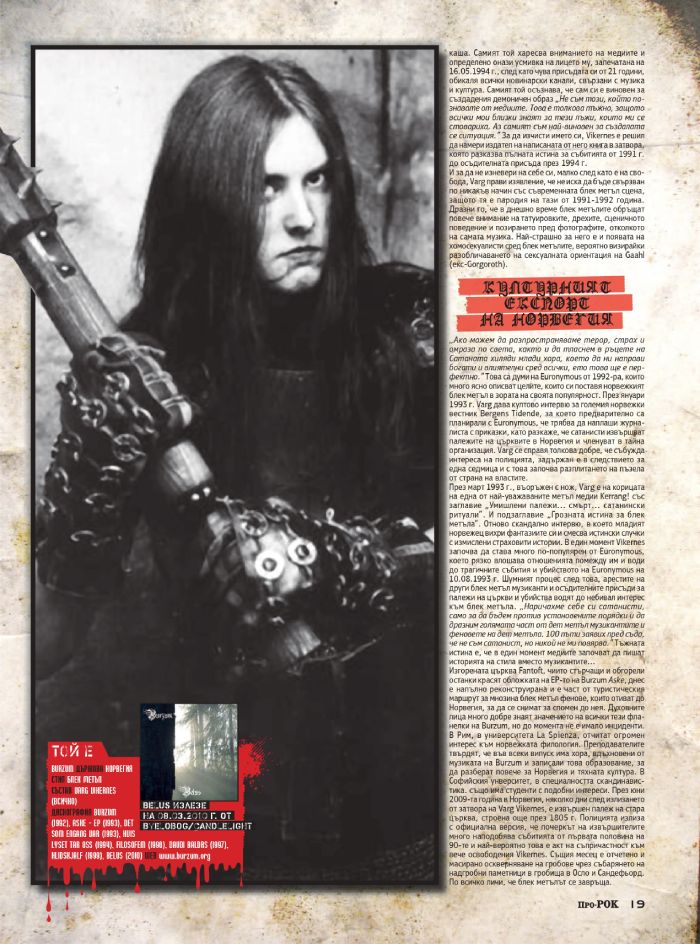
Varg has always been a media darling, not only because of his sharp tongue in interviews, but also because of his unique gift for getting into a mess after every speech. He himself likes the media attention and definitely that smile on his face, sealed on 16.05.1994 after hearing his sentence of 21 years, toured all news channels related to music and culture. He himself realizes that it is his own fault for the created demonic image "I am not the one you know from the media. This is so sad, because all my loved ones know about these lies that have fallen on me. I am most to blame for the situation". In order to clear his name, Vikernes, decided to find a publisher for a book he wrote in prison that tells the full truth about the events of 1991 until his conviction in 1994.
And not to deceive himself, shortly after his release, Varg made a statement that he did not want to be associated in any way with the modern Black Metal scene, because it was a parody of the one from 1991-1992. It annoys him that nowadays Black Metal people pay more attention to tattoos, clothes, stage behaviour and posing for photographers than to music itself. Most frightening for him was the emergence of homosexualists among Black Metal bands, probably referring to the exposure of the sexual orientation of Gaahl (ex-Gorgoroth).
And not to deceive himself, shortly after his release, Varg made a statement that he did not want to be associated in any way with the modern Black Metal scene, because it was a parody of the one from 1991-1992. It annoys him that nowadays Black Metal people pay more attention to tattoos, clothes, stage behaviour and posing for photographers than to music itself. Most frightening for him was the emergence of homosexualists among Black Metal bands, probably referring to the exposure of the sexual orientation of Gaahl (ex-Gorgoroth).
Cultural exports of Norway
"If we can spread terror, fear and hatred around the world, and push thousands of young people into the hands of Satan, making us rich and influential among all, that would be perfect". These are words of Euronymous from 1992 that very clearly describe the goals that Norwegian Black Metal set at the dawn of its popularity. In January 1993 Varg gives a cult interview for the big Norwegian newspaper "Bergens Tidende" (The Bergen Newspaper), which he and Euronymous had planned in advance, to scare the journalist with stories, saying that Satanists are committing arson of churches in Norway and are members of a secret organization. Varg did so well that he piqued the interest of the police, was detained in the investigation for a week, and thus began the unraveling of the puzzle by the authorities.
In March 1993 armed with a knife, Varg is on the cover of one of the most respected metal media "Kerrang!" with the title "Arson... Death... Satanic rituals". And subtitled "The Ugly Truth About Black Metal". Again, a scandalous interview in which the young Norwegian swirls his fantasies and mixes real events with fictional scary stories. At some point, Vikernes began to become much more popular than Euronymous, which sharply worsened their relationship and led to the tragic events and the assassination of Euronymous on 10.08.1993. The subsequent high-profile trial, arrests of other Black Metal musicians, and convictions for church arson and murder led to an unprecedented interest in Black Metal. "We called ourselves Satanists just to be against the established order and to annoy the vast majority of Death Metal musicians and Death Metal fans. I told the court 100 times that I was not a Satanist, but no one believed me". The sad truth is that at some point the media starts writing the story of the genre instead of musicians...
The burnt-out Fantoft Church, which protruding and burned remains adorn the album cover of Burzum EP "Aske", is now completely reconstructed and is part of the tourist route for many Black Metal fans who go to Norway to take a souvenir photo next to it. The clergy are very well aware of the importance of all these Burzum T-shirts, but so far there have been no incidents. In Rome, at the "La Sapienza" university, there is a great interest in Norwegian philology. Teachers say that in every class there are people who are inspired by Burzum the music and have signed up for this education to learn more about Norway and its culture. At the University of Sofia, in the specialty of Scandinavian studies, there are also students with similar interests. In June 2009, in Norway, a few days after Varg Vikernes was released from prison, an old church built in 1805 was set on fire. The police have issued an official version that the handwriting of the perpetrators is very similar to the events of the first half of the 1990s, and most likely, it is an act of sympathy for the already released Vikernes. In the same month, mass grave desecration was reported by demolishing gravestones in cemeteries in Oslo and Sandefjord. Looks like Black metal is back.
In other languages: Български
In March 1993 armed with a knife, Varg is on the cover of one of the most respected metal media "Kerrang!" with the title "Arson... Death... Satanic rituals". And subtitled "The Ugly Truth About Black Metal". Again, a scandalous interview in which the young Norwegian swirls his fantasies and mixes real events with fictional scary stories. At some point, Vikernes began to become much more popular than Euronymous, which sharply worsened their relationship and led to the tragic events and the assassination of Euronymous on 10.08.1993. The subsequent high-profile trial, arrests of other Black Metal musicians, and convictions for church arson and murder led to an unprecedented interest in Black Metal. "We called ourselves Satanists just to be against the established order and to annoy the vast majority of Death Metal musicians and Death Metal fans. I told the court 100 times that I was not a Satanist, but no one believed me". The sad truth is that at some point the media starts writing the story of the genre instead of musicians...
The burnt-out Fantoft Church, which protruding and burned remains adorn the album cover of Burzum EP "Aske", is now completely reconstructed and is part of the tourist route for many Black Metal fans who go to Norway to take a souvenir photo next to it. The clergy are very well aware of the importance of all these Burzum T-shirts, but so far there have been no incidents. In Rome, at the "La Sapienza" university, there is a great interest in Norwegian philology. Teachers say that in every class there are people who are inspired by Burzum the music and have signed up for this education to learn more about Norway and its culture. At the University of Sofia, in the specialty of Scandinavian studies, there are also students with similar interests. In June 2009, in Norway, a few days after Varg Vikernes was released from prison, an old church built in 1805 was set on fire. The police have issued an official version that the handwriting of the perpetrators is very similar to the events of the first half of the 1990s, and most likely, it is an act of sympathy for the already released Vikernes. In the same month, mass grave desecration was reported by demolishing gravestones in cemeteries in Oslo and Sandefjord. Looks like Black metal is back.
Author: Victor Kolev (© 2010 "Pro-Rock" Magazine, Bulgaria)
In other languages: Български