






LIBRARY
Odin rules
Interview with Varg Vikernes
"Ablaze" magazine (#1, 1994)
Marc Spermeth
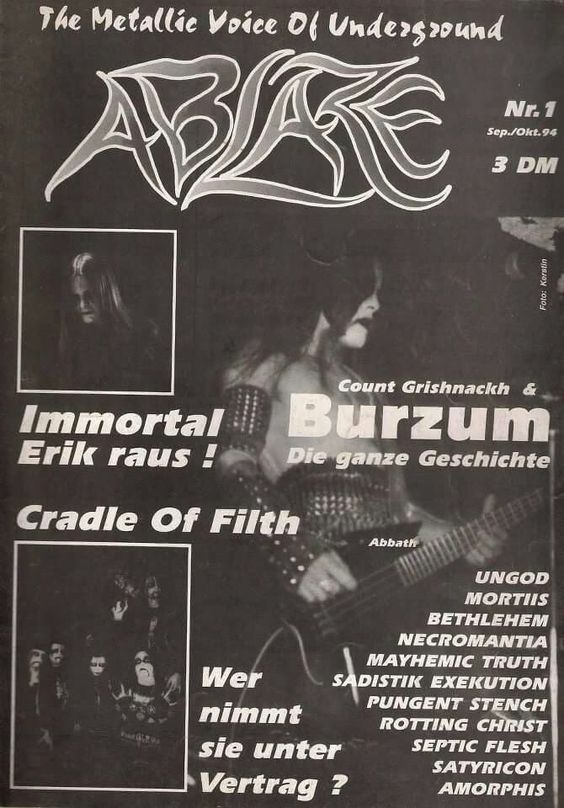
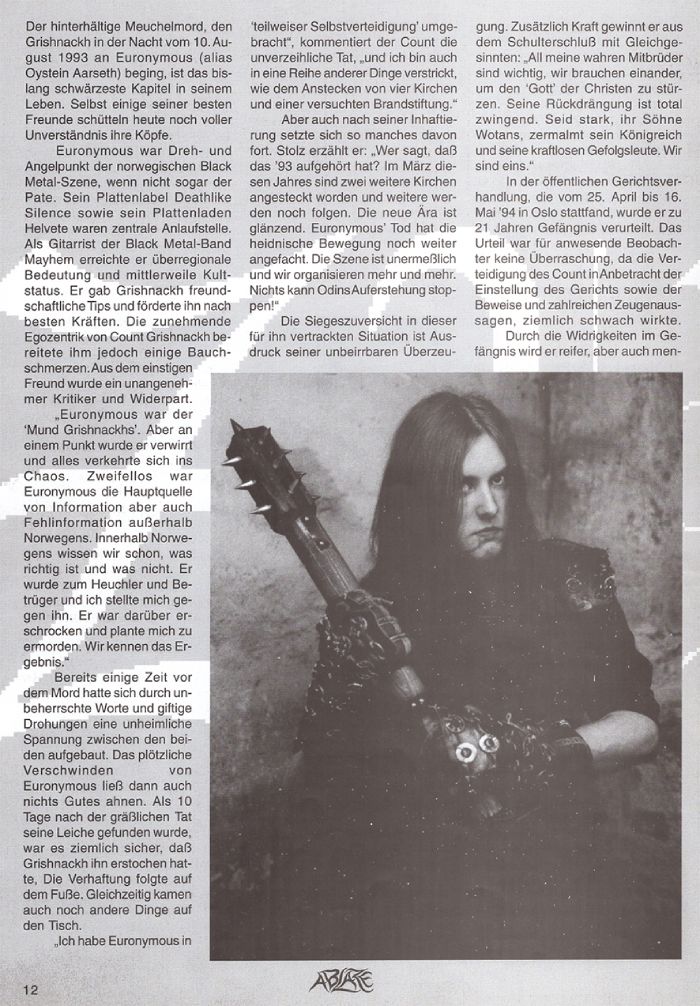
The dark, atmospheric sound of Burzum has a large allegiance in the underground. After the release of the new record "Hvis Lyset Tar Oss", it received a further boost. But Count Grishnackh, the main actor of the one-man band, also has an exceptional position. As clear as the approval for his musical work may be, opinions about his person diverge as much. Numerous rumors fed by misunderstandings, misinterpretations and sometimes lies have painted a very distorted picture of him in the past. For the "Ablaze" Marc Spermeth contacted him to bring clarity into the tangle.
Count Grishnackh was born in Bergen in February 1973 as Varg Vikernes. His native city, the second largest metropolitan area in Norway after Oslo, is located on the west coast of the kingdom. "The original name of the city is Bjǿrgvin. As the former capital of the Hanseatic League, it was given the German name a long time ago", explains the Count, thus revealing his interest in history. As a child, however, he first discovered his preference for music: "Probably at that time I dreamed of becoming a guitar hero or something like that".
At the age of 14 he founded his first band, which he called Uruk-Hai. "Uruk-Hai means "demon race". In my earlier time I was more of a berserker, so the name fit perfectly". Grishnackh's words prove that he lives with his thoughts in a world of legends. In the Norse legend, berserker was used to refer to warriors of bearish strength and ferocity. So the young Varg was bursting with strength and sometimes didn't really know where to put it. "I was a skinhead with the goal of thrashing "reds" as much as possible, really quite amusing. But I grew up and realized that other things in life are far more influential and "destructive". During this time we, Demonaz, Abbath and I, founded Satanel". From the middle of 1990, Grishnackh went through a very instructive and formative time with the two Immortal members. He also played with the Death Metal band Old Funeral.
With Demonaz, who is still his best friend today, he then had the decisive experience. "We were on a trip over Norway's mountains in a "slightly-too-old" car when we almost froze to death in the middle of winter. The cold to some extent took possession of us and completely changed us. I woke up and saw my real self. That was the beginning of 1991 and for me the first and most important event, but certainly not the last".
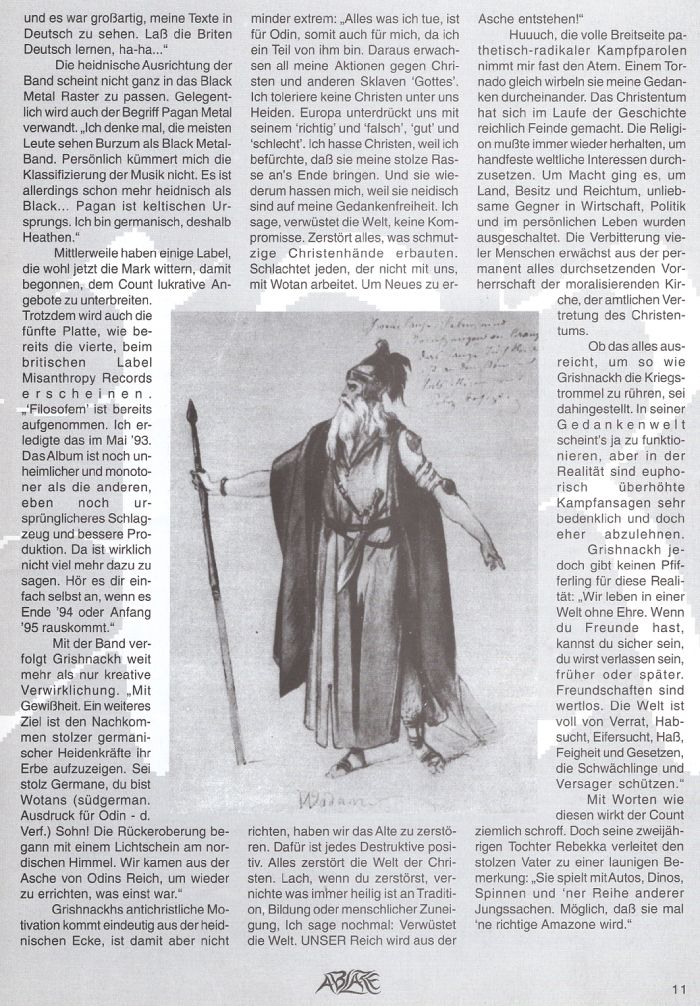
The primal force of nature had impressed him so strongly that he wanted to fathom the supreme sovereign for it. He was engaged in Norse mythology and became "a worshiper of Odin, the god of war and death. He is also the god of wisdom, magic and poetry. These are the things I am looking for". Odin appears as an old man with a big beard, one-eyed, with a floppy hat, wrapped in a blue coat. He brings those who are to die, or has them brought from the battlefield by the demonic Valkyries. So he became the lord of the dead and of a special realm of the dead, the Valhalla, into which he accepts only those who have fallen in battle, so called Einherjer (fallen heroes).
In the middle of 1991 Satanel broke up and Grishnackh revived his old solo band Uruk-Hai. However, the new state of the soul already demanded a different name. "I switched from Uruk-Hai to Burzum shortly afterwards. The name is to be translated as "Odin's light/darkness". Burzum exists exclusively for Odin, the one-eyed enemy of the Christian god..."
The band only works as a solo venture. "I've always avoided integrating other musicians. My strong individualism is against it. In 1992 I once had a bass player for a few months, but then I kicked him out again".
There are now four discs of Burzum. In March 1992, the debut was released, which the Count today calls "the most primitive and hateful Burzum album". A year later came the "Aske" EP and in September 1993 the "Det Som Engang Var" album. The new album "Hvis Lyset Tar Oss" (When the Light Takes Us) was released in April this year. Evocative screech singing corresponds with a flat sound weave of simple, extended guitar riffs and energetic, sometimes almost angry drums. The texts are conveniently enclosed in German translation, which greatly facilitates access to the lyrical content. The count is satisfied: "Everything was really well done. I have to say, the cover and the German translation attracted my attention the most. I really like the German language and it was great to see my texts in German. Let the British learn German, ha-ha..."
The pagan orientation of the band does not seem to fit completely into the Black Metal grid. The term Pagan Metal is also occasionally used. "I think most people see Burzum as a Black Metal band. Personally, I don't care about the classification of music. However, it is already more pagan than black... Pagan is of Celtic origin. I'm Germanic, thus Heathen".
In the meantime, some labels, who probably now smell the profit, have started to make lucrative offers to the Count. Nevertheless, the fifth record, like the fourth, will also be released by the British label Misanthropy Records. ""Filosofem" has already been recorded. I did it in May 1993. The album is even more eerie and monotonous than the others, just more original drums and better production. There's really not much more to say about this. Just listen to it yourself when it comes out in late 1994 or early 1995".
With the band, Grishnackh pursues far more than just creative realization. "With certainty. Another goal is to show the descendants of proud Germanic Gentile forces their heritage. Be proud Germane, you are Wotans (southern German. An expression for Odin - ed.) Son! The reconquest began with a glimmer of light in the Nordic sky. We came from the ashes of Odin's empire to rebuild what was once".
Grishnackh's anti-Christian motivation clearly comes from the pagan corner, but it is no less extreme: "Everything I do is for Odin, therefore also for me, since I am a part of him. From this all my actions against Christians and other slaves of "God" grow. I do not tolerate Christians among us pagans. Europe oppresses us with its "right" and "wrong", "good" and "bad". I hate Christians because I fear that they will bring my proud race to an end. And they, in turn, hate me, because they are envious of my freedom of thought. I say, devastate the world, no compromises. Destroy everything that dirty Christian hands built. Slaughter everyone who does not work with us, with Wotan. In order to build something new, we have to destroy the old. For this, every destructive is positive. Everything that is destroying the world of Christians. Laugh, when you destroy, destroy whatever is sacred in tradition, education or human affection, I say again: devastate the world. OUR kingdom will rise from the ashes!"
Huuuch, the full broadside of pathetically radical battle slogans almost takes my breath away. Like a tornado, they confuse my thoughts. Christianity has made plenty of enemies over the course of history. Religion had to serve again and again in order to assert tangible worldly interests. It was about power, about land, property and wealth, unpleasant opponents in business, politics and personal life were eliminated. The bitterness of many people arises from the permanently all-asserting supremacy of the moralizing church, the official representation of Christianity.
Whether all this is enough to stir the war drum like Grishnackh, is left to be seen. In his world of thoughts it seems to work, but in reality euphorically exaggerated announcements of fights are very questionable and yet rather to be rejected.
Grishnackh, however, does not give a trifle about this reality: "We live in a world without honor. If you have friends, you can be sure, you will be abandoned, sooner or later. Friendships are worthless. The world is full of betrayal, greed, jealousy, hatred, cowardice and laws that protect the weak and deadbeat".
With words like these, the Count seems rather gruff. But his two-year-old daughter Rebekka seduces the proud father into a moody remark: "She plays with cars, dinos, spiders and a bunch of other children stuff. Maybe she'll become a real Amazon one day".
The devious murder committed by Grishnackh on the night of August 10, 1993 against Euronymous (aka Øystein Aarseth) is the blackest chapter in his life to date. Even some of his best friends are still shaking their heads in incomprehension today.
Euronymous was the linchpin of the Norwegian Black Metal scene, if not the godfather. His record label Deathlike Silence and his record store "Helvete" were the central contact point. As the guitarist of the Black Metal band Mayhem, he achieved national significance and has now achieved cult status. He gave Grishnackh friendly tips and promoted him to the best of his ability. However, the increasing egocentricity of Count Grishnackh caused him some stomach pains. The former friend turned into an unpleasant critic and antagonist.
"Euronymous was the "mouth of Grishnackh". But at one point he got confused and everything turned upside down into chaos. Undoubtedly, Euronymous was the main source of information but also misinformation outside Norway. Within Norway we already know what is right and what is not. He became a hypocrite and a deceiver, and I turned against him. He was frightened by this and planned to murder me. We know the result".
Already some time before the murder, an eerie tension had built up between the two through uncontrolled words and poisonous threats. The sudden disappearance of Euronymous then also did not foreshadow anything good. 10 days after the atrocious act when his body was found, it was quite certain that Grishnackh had stabbed him, the arrest followed on the heels. At the same time, other things were also on the table.
"I killed Euronymous in "partial self-defense", the Count comments on the unforgivable act, "and I'm also involved in a number of other things, such as the arson of four churches and an attempted arson".
But even after his imprisonment, some of this continued. He proudly tells: "Who says that the 1993 stopped? In March of this year, two more churches were burned and more will follow. The new era is brilliant. Euronymous's death further fueled the pagan movement. The scene is immense and we are organizing more and more. Nothing can stop Odin's resurrection!"
The assurance of victory in this tricky situation for him is an expression of his unwavering conviction. In addition, he gains strength from joining hands with like-minded people: "All my true confreres are important, we need each other to overthrow the "God" of Christians. His pushback is totally imperative. Be strong, you sons of Wotan, crush his kingdom and his powerless followers. We are one".
At the public court hearing, which took place in Oslo from April 25 to May 16, 1994, he was sentenced to 21 years in prison. The verdict was not a surprise for observers present, as the Count's defense seemed rather weak considering the court's attitude, as well as the evidence and numerous witness statements. The adversities in prison will make him more mature, but also more misanthropic, "in the face of all these human people on the scene". At the earliest after 12 years, the count can expect to be released by pardon. Until then, he must pass the time as well as possible. It is quite fitting that Grishnackh is a friend of spiritual activity.
"I am interested in German history, cosmology, mythology, war games, all kinds of war arts, psychology and more. I could continue indefinitely. Anyway, Odinism interests me the most. I'm making the least music at the moment. It's not even second or third in my interests at the moment". In between, to keep the body fit, he regularly goes to the weights, but then he puts his nose right back in the books. He says enthusiastically: "I will also learn the wonderful German language".
Grishnackh lives in his thoughts, in which his individualism is united with great imagination. Fatefully, he thus becomes a spiritual champion and categorically declares: "Struggle is development. Peace is regression. War is a necessity for the survival of mankind".
"People call me a Satanist, a racist and a Nazi to hurt me and manipulate the magazines and dispersers, which then eventually leads to the boycott. And all this is only because there is a lack of brains in the music business".
The pagan Grishnackh is truly not a Satanist. The Count also vehemently contradicts the accusations of being a racist and a Nazi. The only problem is that his conceptual demarcation is not shared by everyone.
"I love my hometown, my home district, Norway, Scandinavia and the whole of Germany. I love it so much that I have to destroy it in order to rebuild it. That will probably be the way". Grishnackh is imbued with national pride. "Nationalism is the foundation of every nation, the essence of national survival". Such words have earned him the reputation of being a Nazi.
"I am an ELITIST. Nazis, as far as I know, were not individualists and also had other Christian lownesses to themselves. They wrote "God with us" on their belt tensioners. If you had written "Wotan with us", I would have supported it, but then, logically, National Socialism would have turned out completely differently. It would have been Wotanism".
Grishnackh walks on very thin ice. With such, somewhat half-hearted attempts to distance oneself and the use of the Norwegian war flag from the Second World War, it is not surprising if misunderstandings occasionally occur.
"I have Viking blood, Germanic blood, so I belong to Odin's progeny. Me and my race are all that's left of the proud King. I'm not a racist because I don't hate other races. I just love my own gorgeous breed. I am proud of my heritage and I avoid regression and destruction of our race. I will do everything I can to save the remains of Odin, our Germanic blood. This is so important, because if I leave him, my race, then I give up on myself, since I am a part of him".
Unadulterated, authentic words that reflect what drives Grishnackh. He still thinks that focusing on his person is rather bad. The music should be in the foreground. "I'm not here for fame and money. I see Burzum as a dream without any influence on reality. The imagination of mortals should be stimulated, their thoughts should wander".
Interestingly, such terms as Uruk-Hai, Burzum and even the pseudonym Grishnackh are taken from the novel "The Lord of the Rings" by Tolkien. "The book itself is rather boring, but I compare Sauron with Odin, Barad-Dur with Lipskialv (Hliðskjálf), the one ring with Draupnir, Grishnackh with a companion, the Hammer of Morgoth with Mjöllnir, the hammer of Thor, trolls with berserkers, etc. It's a great way to hide the pagan message in Burzum. Why am I doing this? Well, because in this way it is much more esoteric and elitist, so that only the Odinist realizes what it is about".
So the novel character Grishnackh is really the name giver, but is he also an identification person? "In a way, yes. Grishnackh wanted to do things in his own way, just like me. But apart from this common egoism and Sauronian/Odinist devotion, I see nothing to identify with him. We are both partners in Odin's empire".
Einherjers who died in the battle inhabit Valhalla. During the day they go out to fight, but in the evening they come back and spend the night in carouse. They are the closest associates of Odin, who resides in Valhalla on his throne surrounded by his wolves Geri and Freki and his ravens Hugin and Munin. It is only too logical that the Count, for all his adoration for Odin, sees himself as an accomplice: "It's me and it will always be me... until the final end in Ragnarök and maybe beyond?"
Grishnackh has totally internalized the Norse mythology. "I don't agree with everything", he says relativistically on the record. "But I suspect it's because we only know the Christian interpretation. If cosmology had been protected and not Christianized, it would probably be completely different from what we know it today. I don't believe the stories too much, but I do believe the symbols and maybe the distant forefathers. The Hammer of Thor is an ideology. Hugin and Munin are Odin's stellar and unearthly bodies, as well as thought and memory, his lost eye is the human feelings that he sacrificed to gain wisdom and true reason, Loki is the personification of Odin's shadow side, etc... Perhaps everything was on the island of Atlantis, which sank. Maybe we are the descendants of the Atlanteans, I don't know. Maybe we'll never know..."
In other languages: Deutsch
Count Grishnackh was born in Bergen in February 1973 as Varg Vikernes. His native city, the second largest metropolitan area in Norway after Oslo, is located on the west coast of the kingdom. "The original name of the city is Bjǿrgvin. As the former capital of the Hanseatic League, it was given the German name a long time ago", explains the Count, thus revealing his interest in history. As a child, however, he first discovered his preference for music: "Probably at that time I dreamed of becoming a guitar hero or something like that".
At the age of 14 he founded his first band, which he called Uruk-Hai. "Uruk-Hai means "demon race". In my earlier time I was more of a berserker, so the name fit perfectly". Grishnackh's words prove that he lives with his thoughts in a world of legends. In the Norse legend, berserker was used to refer to warriors of bearish strength and ferocity. So the young Varg was bursting with strength and sometimes didn't really know where to put it. "I was a skinhead with the goal of thrashing "reds" as much as possible, really quite amusing. But I grew up and realized that other things in life are far more influential and "destructive". During this time we, Demonaz, Abbath and I, founded Satanel". From the middle of 1990, Grishnackh went through a very instructive and formative time with the two Immortal members. He also played with the Death Metal band Old Funeral.
With Demonaz, who is still his best friend today, he then had the decisive experience. "We were on a trip over Norway's mountains in a "slightly-too-old" car when we almost froze to death in the middle of winter. The cold to some extent took possession of us and completely changed us. I woke up and saw my real self. That was the beginning of 1991 and for me the first and most important event, but certainly not the last".
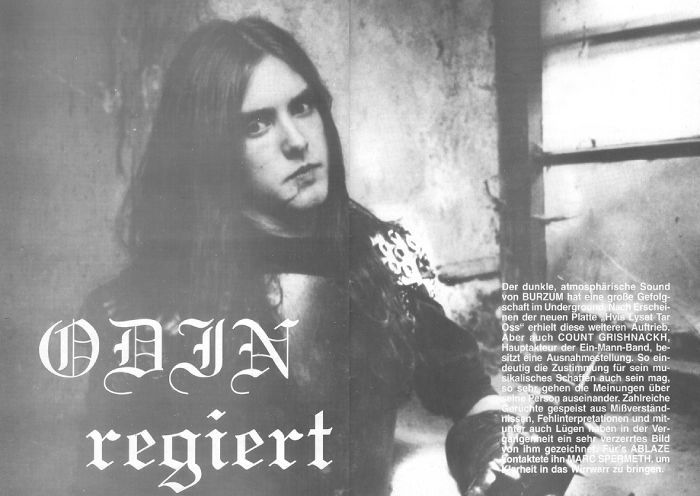
The primal force of nature had impressed him so strongly that he wanted to fathom the supreme sovereign for it. He was engaged in Norse mythology and became "a worshiper of Odin, the god of war and death. He is also the god of wisdom, magic and poetry. These are the things I am looking for". Odin appears as an old man with a big beard, one-eyed, with a floppy hat, wrapped in a blue coat. He brings those who are to die, or has them brought from the battlefield by the demonic Valkyries. So he became the lord of the dead and of a special realm of the dead, the Valhalla, into which he accepts only those who have fallen in battle, so called Einherjer (fallen heroes).
In the middle of 1991 Satanel broke up and Grishnackh revived his old solo band Uruk-Hai. However, the new state of the soul already demanded a different name. "I switched from Uruk-Hai to Burzum shortly afterwards. The name is to be translated as "Odin's light/darkness". Burzum exists exclusively for Odin, the one-eyed enemy of the Christian god..."
The band only works as a solo venture. "I've always avoided integrating other musicians. My strong individualism is against it. In 1992 I once had a bass player for a few months, but then I kicked him out again".
There are now four discs of Burzum. In March 1992, the debut was released, which the Count today calls "the most primitive and hateful Burzum album". A year later came the "Aske" EP and in September 1993 the "Det Som Engang Var" album. The new album "Hvis Lyset Tar Oss" (When the Light Takes Us) was released in April this year. Evocative screech singing corresponds with a flat sound weave of simple, extended guitar riffs and energetic, sometimes almost angry drums. The texts are conveniently enclosed in German translation, which greatly facilitates access to the lyrical content. The count is satisfied: "Everything was really well done. I have to say, the cover and the German translation attracted my attention the most. I really like the German language and it was great to see my texts in German. Let the British learn German, ha-ha..."
The pagan orientation of the band does not seem to fit completely into the Black Metal grid. The term Pagan Metal is also occasionally used. "I think most people see Burzum as a Black Metal band. Personally, I don't care about the classification of music. However, it is already more pagan than black... Pagan is of Celtic origin. I'm Germanic, thus Heathen".
In the meantime, some labels, who probably now smell the profit, have started to make lucrative offers to the Count. Nevertheless, the fifth record, like the fourth, will also be released by the British label Misanthropy Records. ""Filosofem" has already been recorded. I did it in May 1993. The album is even more eerie and monotonous than the others, just more original drums and better production. There's really not much more to say about this. Just listen to it yourself when it comes out in late 1994 or early 1995".
With the band, Grishnackh pursues far more than just creative realization. "With certainty. Another goal is to show the descendants of proud Germanic Gentile forces their heritage. Be proud Germane, you are Wotans (southern German. An expression for Odin - ed.) Son! The reconquest began with a glimmer of light in the Nordic sky. We came from the ashes of Odin's empire to rebuild what was once".
Grishnackh's anti-Christian motivation clearly comes from the pagan corner, but it is no less extreme: "Everything I do is for Odin, therefore also for me, since I am a part of him. From this all my actions against Christians and other slaves of "God" grow. I do not tolerate Christians among us pagans. Europe oppresses us with its "right" and "wrong", "good" and "bad". I hate Christians because I fear that they will bring my proud race to an end. And they, in turn, hate me, because they are envious of my freedom of thought. I say, devastate the world, no compromises. Destroy everything that dirty Christian hands built. Slaughter everyone who does not work with us, with Wotan. In order to build something new, we have to destroy the old. For this, every destructive is positive. Everything that is destroying the world of Christians. Laugh, when you destroy, destroy whatever is sacred in tradition, education or human affection, I say again: devastate the world. OUR kingdom will rise from the ashes!"
Huuuch, the full broadside of pathetically radical battle slogans almost takes my breath away. Like a tornado, they confuse my thoughts. Christianity has made plenty of enemies over the course of history. Religion had to serve again and again in order to assert tangible worldly interests. It was about power, about land, property and wealth, unpleasant opponents in business, politics and personal life were eliminated. The bitterness of many people arises from the permanently all-asserting supremacy of the moralizing church, the official representation of Christianity.
Whether all this is enough to stir the war drum like Grishnackh, is left to be seen. In his world of thoughts it seems to work, but in reality euphorically exaggerated announcements of fights are very questionable and yet rather to be rejected.
Grishnackh, however, does not give a trifle about this reality: "We live in a world without honor. If you have friends, you can be sure, you will be abandoned, sooner or later. Friendships are worthless. The world is full of betrayal, greed, jealousy, hatred, cowardice and laws that protect the weak and deadbeat".
With words like these, the Count seems rather gruff. But his two-year-old daughter Rebekka seduces the proud father into a moody remark: "She plays with cars, dinos, spiders and a bunch of other children stuff. Maybe she'll become a real Amazon one day".
The devious murder committed by Grishnackh on the night of August 10, 1993 against Euronymous (aka Øystein Aarseth) is the blackest chapter in his life to date. Even some of his best friends are still shaking their heads in incomprehension today.
Euronymous was the linchpin of the Norwegian Black Metal scene, if not the godfather. His record label Deathlike Silence and his record store "Helvete" were the central contact point. As the guitarist of the Black Metal band Mayhem, he achieved national significance and has now achieved cult status. He gave Grishnackh friendly tips and promoted him to the best of his ability. However, the increasing egocentricity of Count Grishnackh caused him some stomach pains. The former friend turned into an unpleasant critic and antagonist.
"Euronymous was the "mouth of Grishnackh". But at one point he got confused and everything turned upside down into chaos. Undoubtedly, Euronymous was the main source of information but also misinformation outside Norway. Within Norway we already know what is right and what is not. He became a hypocrite and a deceiver, and I turned against him. He was frightened by this and planned to murder me. We know the result".
Already some time before the murder, an eerie tension had built up between the two through uncontrolled words and poisonous threats. The sudden disappearance of Euronymous then also did not foreshadow anything good. 10 days after the atrocious act when his body was found, it was quite certain that Grishnackh had stabbed him, the arrest followed on the heels. At the same time, other things were also on the table.
"I killed Euronymous in "partial self-defense", the Count comments on the unforgivable act, "and I'm also involved in a number of other things, such as the arson of four churches and an attempted arson".
But even after his imprisonment, some of this continued. He proudly tells: "Who says that the 1993 stopped? In March of this year, two more churches were burned and more will follow. The new era is brilliant. Euronymous's death further fueled the pagan movement. The scene is immense and we are organizing more and more. Nothing can stop Odin's resurrection!"
The assurance of victory in this tricky situation for him is an expression of his unwavering conviction. In addition, he gains strength from joining hands with like-minded people: "All my true confreres are important, we need each other to overthrow the "God" of Christians. His pushback is totally imperative. Be strong, you sons of Wotan, crush his kingdom and his powerless followers. We are one".
At the public court hearing, which took place in Oslo from April 25 to May 16, 1994, he was sentenced to 21 years in prison. The verdict was not a surprise for observers present, as the Count's defense seemed rather weak considering the court's attitude, as well as the evidence and numerous witness statements. The adversities in prison will make him more mature, but also more misanthropic, "in the face of all these human people on the scene". At the earliest after 12 years, the count can expect to be released by pardon. Until then, he must pass the time as well as possible. It is quite fitting that Grishnackh is a friend of spiritual activity.
"I am interested in German history, cosmology, mythology, war games, all kinds of war arts, psychology and more. I could continue indefinitely. Anyway, Odinism interests me the most. I'm making the least music at the moment. It's not even second or third in my interests at the moment". In between, to keep the body fit, he regularly goes to the weights, but then he puts his nose right back in the books. He says enthusiastically: "I will also learn the wonderful German language".
Grishnackh lives in his thoughts, in which his individualism is united with great imagination. Fatefully, he thus becomes a spiritual champion and categorically declares: "Struggle is development. Peace is regression. War is a necessity for the survival of mankind".
"People call me a Satanist, a racist and a Nazi to hurt me and manipulate the magazines and dispersers, which then eventually leads to the boycott. And all this is only because there is a lack of brains in the music business".
The pagan Grishnackh is truly not a Satanist. The Count also vehemently contradicts the accusations of being a racist and a Nazi. The only problem is that his conceptual demarcation is not shared by everyone.
"I love my hometown, my home district, Norway, Scandinavia and the whole of Germany. I love it so much that I have to destroy it in order to rebuild it. That will probably be the way". Grishnackh is imbued with national pride. "Nationalism is the foundation of every nation, the essence of national survival". Such words have earned him the reputation of being a Nazi.
"I am an ELITIST. Nazis, as far as I know, were not individualists and also had other Christian lownesses to themselves. They wrote "God with us" on their belt tensioners. If you had written "Wotan with us", I would have supported it, but then, logically, National Socialism would have turned out completely differently. It would have been Wotanism".
Grishnackh walks on very thin ice. With such, somewhat half-hearted attempts to distance oneself and the use of the Norwegian war flag from the Second World War, it is not surprising if misunderstandings occasionally occur.
"I have Viking blood, Germanic blood, so I belong to Odin's progeny. Me and my race are all that's left of the proud King. I'm not a racist because I don't hate other races. I just love my own gorgeous breed. I am proud of my heritage and I avoid regression and destruction of our race. I will do everything I can to save the remains of Odin, our Germanic blood. This is so important, because if I leave him, my race, then I give up on myself, since I am a part of him".
Unadulterated, authentic words that reflect what drives Grishnackh. He still thinks that focusing on his person is rather bad. The music should be in the foreground. "I'm not here for fame and money. I see Burzum as a dream without any influence on reality. The imagination of mortals should be stimulated, their thoughts should wander".
Interestingly, such terms as Uruk-Hai, Burzum and even the pseudonym Grishnackh are taken from the novel "The Lord of the Rings" by Tolkien. "The book itself is rather boring, but I compare Sauron with Odin, Barad-Dur with Lipskialv (Hliðskjálf), the one ring with Draupnir, Grishnackh with a companion, the Hammer of Morgoth with Mjöllnir, the hammer of Thor, trolls with berserkers, etc. It's a great way to hide the pagan message in Burzum. Why am I doing this? Well, because in this way it is much more esoteric and elitist, so that only the Odinist realizes what it is about".
So the novel character Grishnackh is really the name giver, but is he also an identification person? "In a way, yes. Grishnackh wanted to do things in his own way, just like me. But apart from this common egoism and Sauronian/Odinist devotion, I see nothing to identify with him. We are both partners in Odin's empire".
Einherjers who died in the battle inhabit Valhalla. During the day they go out to fight, but in the evening they come back and spend the night in carouse. They are the closest associates of Odin, who resides in Valhalla on his throne surrounded by his wolves Geri and Freki and his ravens Hugin and Munin. It is only too logical that the Count, for all his adoration for Odin, sees himself as an accomplice: "It's me and it will always be me... until the final end in Ragnarök and maybe beyond?"
Grishnackh has totally internalized the Norse mythology. "I don't agree with everything", he says relativistically on the record. "But I suspect it's because we only know the Christian interpretation. If cosmology had been protected and not Christianized, it would probably be completely different from what we know it today. I don't believe the stories too much, but I do believe the symbols and maybe the distant forefathers. The Hammer of Thor is an ideology. Hugin and Munin are Odin's stellar and unearthly bodies, as well as thought and memory, his lost eye is the human feelings that he sacrificed to gain wisdom and true reason, Loki is the personification of Odin's shadow side, etc... Perhaps everything was on the island of Atlantis, which sank. Maybe we are the descendants of the Atlanteans, I don't know. Maybe we'll never know..."
Author: Marc Spermeth (© 1994 "Ablaze" magazine, Germany)
In other languages: Deutsch
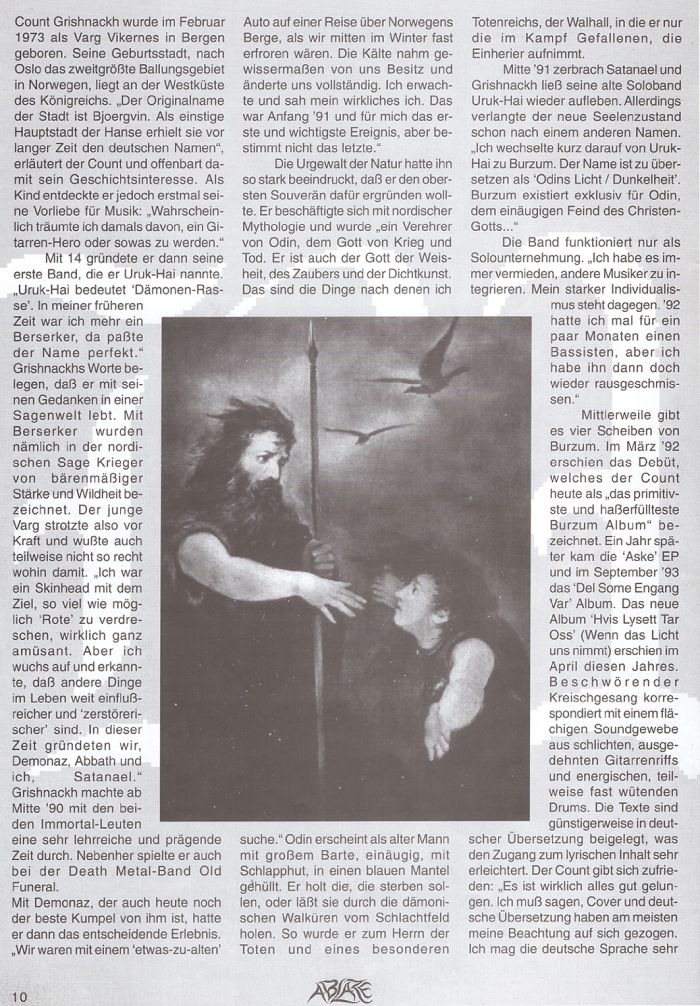
The metallic voice of underground